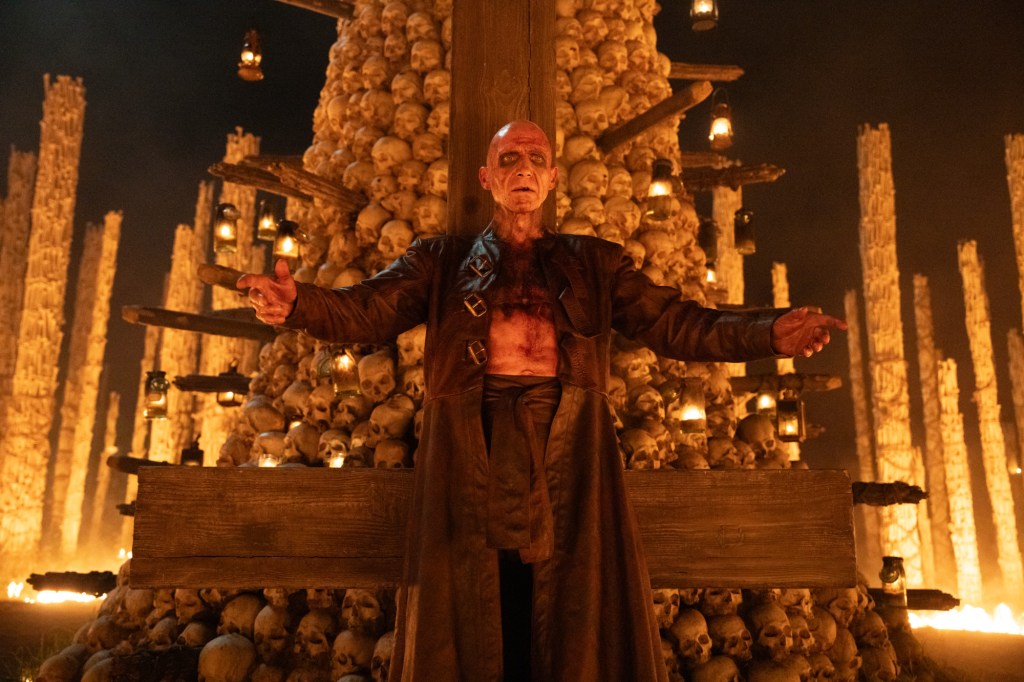
Two decades was a worthy waiting period for the third installment of the beloved British zombie series, but nary a year has passed before we’ve been graced with more. Named for the memento mori crafted by the series’ most tender character, 28 Years Later: The Bone Temple continues the terrifying tale of a deadly infection while never shedding the warmth that makes the series worth returning to. With Ralph Fiennes leading the film’s sweetest, mad, and most jarring moments, this follow up feature gives more weight to the idea that this might be the most consistently powerful cinema franchise.
Picking up where the last film left off, Spike (Alfie Williams)- who is now called “Jimmy” – has become a reluctant new member of Jimmy’s fingers. He is initiated via a gruesome fight to the death, and his prize is that he must don a shaggy blonde wig, give up his personal identity, and submit to the whims of Sir Lord Jimmy Crystal (Jack O’Connell) and his violent delights. Much like Jim and Selena before him, Spike has been absorbed by a nightmare group of humans he must depend upon for survival.
Meanwhile and elsewhere, Dr. Ian Kelson (Ralph Fiennes, in an extension of a career defining performance within a career full up with them) is still studying the whims of the beasts in the woods, coming closer to an Alpha he’s named Samson (Chi Lewis-Parry). Samson, a spine ripping brain-eater, seems to find solace in Kelson’s choice weapon: a tranquilizer dart full up with morphine. Though the conversation is one sided, the communication is not, and Kelson’s dart provides an opening for him to consider if the infected have truly departed from their humanity.
The two groups might never cross, but Sir Jimmy is placed at the feet of Kelson when one of the members of his squad mistakes him for “Old Nick,” or Satan as it were, the man from whom Sir Jimmy claims to have gotten his status and marching orders.
The two prime stories are interspliced and carry with them distinct tones, the two tones that have made the 28 series such a lasting view of humanity in the time of gruesome crisis. The Jimmys’ are violent and cruel, their tribulations bloody and ablaze. Kelson and Samson experience tenderness, fear, hope, and a simple world where pieces of humanity are clutched to by a man in a world without any. Newcomer director, Nia DaCosta (Candyman, Hedda, et al) takes the reins from Danny Boyle who directed 28 Days Later and 28 Years Later and continues to prove herself one of the most important working filmmakers. She has dipped her toes into a well-established sandbox and managed to make the film feel completely consistent to the franchise while bringing her own voice to it. There’s less of the shaky cam panicked violence and more of the tender moments and brighter blood which makes everything feel familiar while fresh.
So much is jammed into what is purported to be a second installment in a new trilogy, but it never feels overstuffed. A second part can be doomed to feel like a bridge between a new story and its finale, but 28 Years Later: The Bone Temple (which is still written by series scribe, Alex Garland) refuses to let that neuter its stakes. Anyone can die, and stories are brought to natural conclusions in time to welcome new ones for the presumed finale. Further, things about the infected are escalated in ways that will leave zombie nerds flipping through notebook pages, wondering if we’ve ever seen the infected in these lights before. Have we seen them at rest? Consuming brains? Just being? It’s sometimes hard to accept such a twist on the franchise (and genre) but damn if it’s not compelling.
It’s perhaps tired from me, but it continues to be magical how this series represents the modern world. Tales of clutching to elements of joy in a world where one cannot let their guard down, and what it means to be alive on a cruel planet that didn’t come together for a global crisis seem ever prescient and increasingly beautiful. “I remember the certainty,” Kelson reflects, something people in this era might look back upon with a fleeting affection. Good luck to the rest of 2026 because it’s going to be difficult to best this titan.
28 Years Later: The Bone Temple hits theaters January 16, 2026
 The Smash List