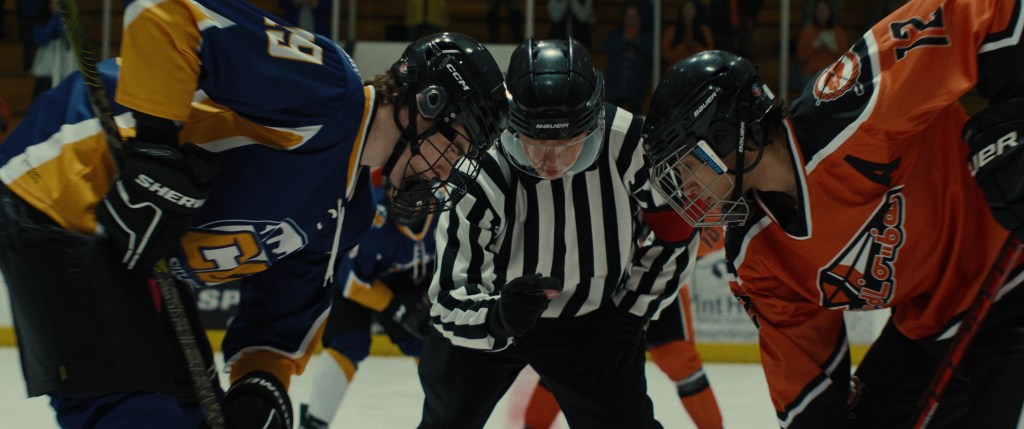
When describing the iteration of his decade-in-the-making hockey movie, Cody Lightning explained how his comedy morphed into a dramedy the more he explored the heavy concepts related to his story. For young indigenous hockey players, racism, sexism, drugs, poverty, and the like informed the themes of his story which altered its genre.
And though they’re ultimately on different ice rinks, his story has a lot in common with everyone’s favourite story of an underdog hockey team, The Mighty Ducks. A messy, begrudged coach, a coed team, a player who’s outgrown the league, and a league they have to try to live up to all inform the story of both of these teams, but with the Cree creator steeping his in indigeneity, there are marked differences in themes and tone.
The Treat 6 Blades are a struggling rag tag group. Their skillset is spread and they experience overt racism from the league and their rough coach (Ed Helms, playing against type as a harsh retired hockey player raining terror upon his team). When they’re kicked out of their league for playing rough (one bad hit is all it takes for a team of indigenous youth), they band together with a scrappy new coach in it for all the wrong reasons. The kids have big dreams that they hope hockey can deliver to them, so losing a league spot is an unfathomable hit. They’ll have to rely on their coach to straighten himself up and then them so they can have a chance at battling on the ice in a world where fairness isn’t an option.
Though the team and coach are scrappy and rag tag, this is hardly a comedy story. The kids’ parents struggle with drugs, money, and views on sexuality. The kids themselves are forced to manage that on their own, if that means begging for their equipment back from a pawn shop or bearing the weight of being a family’s golden goose. Lightning’s story is often pitch black, and he resists even a quip on the ice for levity.
But that’s the story he’s telling, something different from the snappy funny indigenous hockey tales peppered into Letterkenny or Shoresy. He’s not shying away from a bleak reality, he is using hockey to portray it and also to create a space of hope and light for the youth on his screen.
The hockey scenes don’t always look smooth or professional, though some of the actors are hockey players first. But there’s a distinct awareness of shooting (film, not pucks) on the ice, and scenes in the rink look slick though naturalistic. Much of the drama takes place in a dingy bar, a chipping locker room, or a rink’s parking lot which will feel like familiar locales for life for anyone who’s been a youth chasing the show (or anyone who’s consumed other hockey flicks like Goon). The story feels true and honest and gives hope to young people up against odds they might not be able to overcome.
Smudge the Blades isn’t a feel-good underdog sports story, but it shares that DNA. It’s a sometimes bleak but otherwise beautiful story about team sports and how they create found family, opportunity, and camaraderie in a world where you’re asked to shoot from the red line.
 There are always moments when I bring up Westworld and someone responds “I don’t like Westerns.” And often, I retort “well it’s more of a Sci-Fi than it is a Western.” But, as someone who also never liked Westerns, I think I need a new retort. Maybe I watched the wrong kind.
 It’s buddy cop day. More specifically, it’s ‘buddy cop flipped on its side’ day. Loyal followers have already seen the post below which is a buddy cop movie flipped onto it’s 60s Irish side making for a darker over the top comedy.
  It’s the end of September, and I am already on my Hallowe’en horror grind. It is taking a lot out of me to push back some great horror posts in favour of something a little more reminiscent of the waning Summer.
 Guys, I am still pretty sure the end of the world is imminent, and we’re way passed Idiocracy.
 As I sat watching the first two awards announced at the Oscars, fighting with my cable box for its inability to play “Room,” I realized all I needed for real Sunday entertainment was my DVD collection, and
