movie-reviews

‘Passenger’ Takes the Haunted House to the Open Road

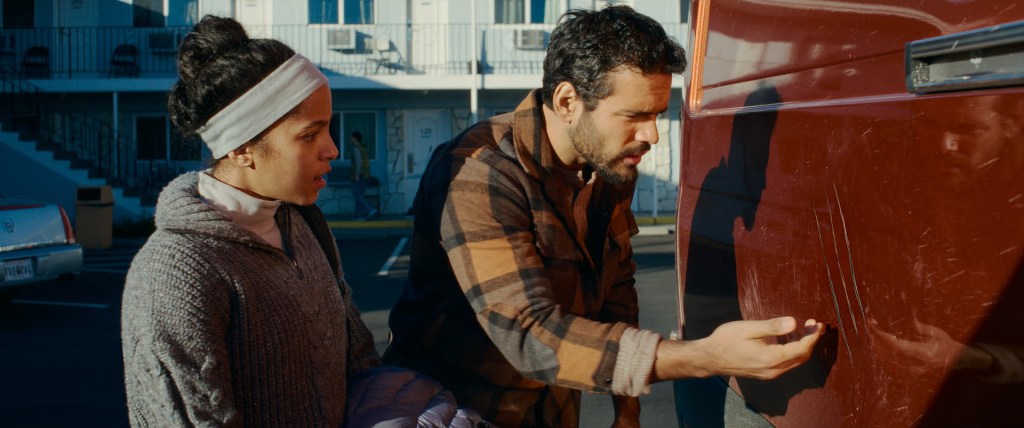
Lou Llobell as “Maddie” and Jacob Scipio as “Tyler” in Passenger from Paramount Pictures.

It’s easy to throw around a word like “formulaic” (you know I certainly have) but it’s harder to understand the nuance of it. “Formulaic,” doesn’t mean unoriginal, “familiar,” doesn’t mean predictable, and “popcorn,” never means bad. So I wield these words with intention as I describe André Øvredal’s haunted mobile-house story, a formulaic and familiar popcorn fright that is made extra-enjoyable with his firm grasp on crafting creative scares.

For his newest nightmare (known for Scary Stories to Tell in the Dark and the terrifying The Autopsy of Jane Doe), Øvredal directed T.W. Burgess and Zachary Donahue’s script about a haunting on the open road. Tyler and Maddie (Jacob Scipio and Lou Llobell) are a young couple in love who’ve traded in their mundane jobs and Brooklyn apartment for the “van life.” Gussying up a vintage Mercedes van, they’ve rid themselves of most of their worldly belongings for the nomadic life of camping, driving, and a bevy of americana. Maddie is reluctant about this life without a secure space with four real walls, but she loves Tyler enough to let him live out his fantasy… for as long as she can stand it. But things go south (or whichever way they’re cruising along Route 66) quickly when the duo come across a mysterious car crash and a legend about a passenger and his mark of three slashes. Haunted, their van becomes a punishing place to lay their heads, and they must follow the hobo code to avoid torture at the hands of this demonic presence.

The pair are green in their nomadic lifestyle, and no amount of YouTube video preparation is enough to protect them, they’ll need the sage wisdom of the OG van-lifers as represented by a reluctant but helpful Melissa Leo as Diana. Learning to respect the road as an entity of its own with its own set of rules might be what saves the pair and gets them to a hot shower, food delivery, and brick instead of steel.

So like I said, pretty formulaic. A loving couple with some relationship strife happens upon an invasive entity and requires the wisdom of a sage older woman to try and break the curse. And all of it is an absolute road trip blast.

Øvredal is no slouch when it comes to crafting scares, and the director delivers some exceptional horror sequences here. From the lived-in cold open that’s reminiscent of Cloverfield to a phenomenal long parking lot sequence, he builds so much lasting tension that a jump scare is barely enough to vent out the amount of developed steam. Relocating a home to a moving vehicle allows for new external threats, plays with security cameras, rules about when and when you can’t move, and of course, so many parking spots. If you’ve ever begged for the family to just drive away from the haunted house (as once subverted in Sinister), you’ll be screaming about keys and tires when you resolve that driving away is to remain in their house.

Things like using headlights and projectors as a light source, dash cam footage, and sending the concept to a highway all make the scares fun and unique, even if the ghost design does not. The entity itself is pretty drab, and it’s at its best when it’s off screen doing the impossible. Rules and intentions are a bit difficult to track so the stakes are tricky to muster, and while lots of audience buy-in relies on Scipio’s charm, the pair isn’t the most enveloping with their horror performances. (Then theirs Leo’s thankless role which trades some time with her for a surprise fright).

So is Passenger a boundary breaking terror built on complex themes? Maybe not. It’s a formulaic and familiar popcorn horror movie filled to the brim with crafty scares and isn’t that such a beautiful thing?

Passenger hits theaters May 22, 2026
‘Undertone’ is High Fidelity Horror That’s a Tight, Relentless, Sonic Terror

VVS Films/ Dustin Rabin

When it was still doing the festival circuit, I listed Undertone as one of the best horror movies coming out of Fantasia 2025. I described it as being like experiencing Paranormal Activity if it was in audio format, so it delighted but didn’t surprise me that during the run, director Ian Tuason was grabbed to helm the eighth installment. Now with a shiny new title card from A24, fresh voice acting (hello, Adam DiMarco), a tightened title (“drop the ‘the’”), and a tenser edit (from Sonny Atkins), Undertone is ready to terrify a larger audience with its punishing audio track.

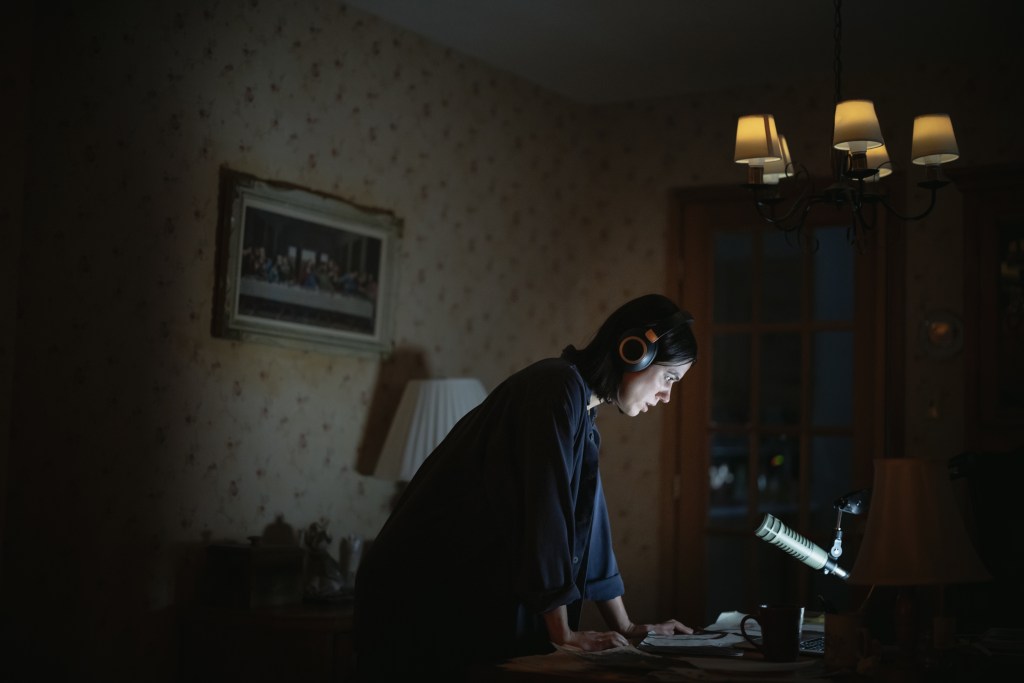
Evy (Nina Kiri) and Justin (DiMarco) are a pair of podcast hosts who squeeze recordings into their challenging schedules. Justin is recording from the UK and Evy is marooned to her childhood home to provide support for her mother’s palliative care, so the duo records their spooky show at 3:00am her time. Typically playing off each other as the skeptic-versus-the-believer exploring supernatural true crime phenomena, the two enter strange new territory when they live record their reactions to ten audio clips sent to the show via cryptic email. The clips start off like the early moments in the aforementioned Paranormal Activity, with audio of Mike (Jeff Yung) recording his partner, Jessa (Keana Lyn Bastidas) talking in her sleep, but things escalate when Jessa starts singing haunting kid’s songs in reverse. The duo does their best to plow through the remaining audio to cobble together a compelling episode, but they’re often interrupted by a need for sleep, an urgent call, or a bump in the night.

Evy has mostly protected herself from fear with her skepticism, but that changes when she finds herself connecting more and more to the audio. As references to the demon Abyzou ramp up, Evy considers if she is the next target for a malevolent force whose screams seem to transcend her plane.

Again, Undertone lives and dies by its audio, the entire movie taking place in a single location with Evy’s headphones as a gateway between worlds. Every crunch of cereal, whistle of a kettle, or tick of a clock is an anti-ASMR stab in the ear creating a persistent sense of unease. The audio is invasive, taking up space in Evy’s home, asking the audience to consider what might have taken place just over her shoulder. Tuason and his DOP, Graham Beasley, went to the Mike Flanagan and Leigh Whannel school of weaponizing negative space and they use empty corners of Evy’s house to ask the audience to use their imaginations and the audio to fill in haunts. Shots of Evy’s back leave her looking so vulnerable to the tin cans placed atop her ears. The only faces we ever truly see are Evy’s and her mother’s, forcing us into her same isolation. Evy might leave the house, but the camera doesn’t and paired with toggling shots between Evy or the entity’s POV, it makes the entire experience claustrophobic forcing the audience to fester in dreadful seclusion.

Undertone is sometimes a grab bag of horror hits, taking its concept of an audio track as a conduit and decorating it with religious iconography, haunted songs and myths, and even a fugue state crayon scratch of something scary. But with that, its guerilla Canadian horror filmmaking at its finest; a liminal horror feature put together by scrappy bubbling creatives. The set is the director’s house, the audio clips were recorded before principal photography, and death rattles and in-world phone calls were recorded by sound guys into iPhones. Something that started with everyone on set placing objects in frame then hiding to add scares to long shots turned into an entire theater reacting to a mirror scare like the audience gasping at the wall climber in Hereditary.

Undertone is a refreshing flip on screen life that uses phone calls and audio clips to bring a large story into the small room of a target protagonist. Is it a lesson in catholic guilt for a skeptic who’s been avoiding her mother’s religious zeal? Perhaps. But above all, it’s a tight and contained terror that will leave audiences trying to find a way to use their blanket to cover their ears.

Undertone hists theaters March 13, 2026